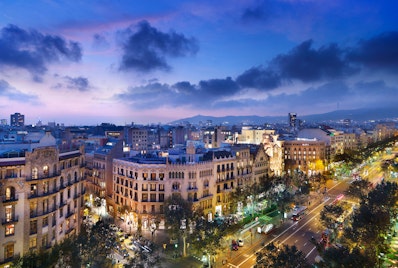
The Mandarin Hotel, located on the Paseo de Gracia in Barcelona, is the result of a complex architectural exercise that resolves, with elegance and skill, the placement of an internationally oriented projection facility within a post-war Spanish building situated in the heart of the Cerdá expansion.
The intervention carried out on the former headquarters of the Banco Hispano Americano, one of the engines of the Spanish post-war economy, stems from an urban reflection that consists of understanding the building’s access as an extension of the Paseo de Gracia, which should allow the continuity of the public space within it.
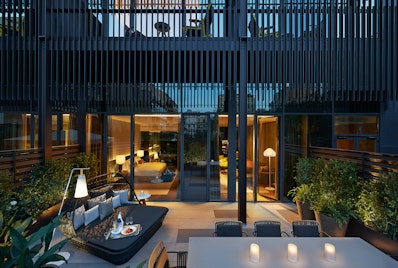
With this objective, a longitudinal axis is designed, which connects the building from the street to the interior of the block. This axis is a route that runs from the Paseo de Gracia through the following sequence: the Paseo de Gracia, the entrance portico located on the main façade, the access ramp, which offers an ascending route and allows a drop-off in a central position within the building, the light atrium, which receives natural illumination through the overhead glass skylight and artificial light, the arrival on the “mezzanine” level, where the entrance to the hotel’s enclosed premises is located and, finally, the interior of the block, where the terrace-garden is located dominated by the strong presence of the inner façade, whose intervention has consisted of providing a “veil” to the original structure of the building, preserving its volumetry.